The Asymmetry No CIO Can Afford to Ignore
I have spent the better part of two decades helping enterprises modernize their technology infrastructure. I have seen many threat reports come and go, most of them compelling at the moment, quickly filed and forgotten.
But this one is different. Not because of its urgency, which is real, but because of what it reveals about the structural nature of the problem we now face.
When Anthropic’s unreleased model, Mythos, identified thousands of high-severity vulnerabilities across every major operating system and browser including flaws that survived decades of human review and millions of automated security tests – it did not just expose software weaknesses. It exposed the fundamental asymmetry that now defines enterprise cybersecurity.
Attackers now iterate faster than defenders can patch. This is a permanent structural shift.
The attack loop has compressed from weeks to hours. Defenders, in most organizations I speak with, are still operating on human timescales. This demands a response at the architectural level, not just at the tooling level.
The Scale of What We Are Actually Dealing With
The numbers in this brief are not projections. They are present-tense realities.
$2.5 trillion in U.S. IT and OT assets are currently exposed. Upgrade costs run to $1 trillion. The chips needed to close the hardware gap are sold out through 2027. And 63% of organisations globally still report insufficient cyber-resilience – even as the industry spends towards a $270 billion market by 2030.
CIOs who treat this as the former will spend more and achieve less. I have seen this pattern repeat itself, and it is one of the things that motivated Galent’s approach from the start.
The IT/OT Divide Is the Most Underestimated Risk in the Portfolio
Most enterprise security conversations centre on IT, and understandably so. IT systems are large, generally manageable, and patchable in most failure scenarios.
But OT is where I lose sleep.
U.S. OT assets total $1 trillion. 50% are unpatchable not because organisations lack the will, but because patching often means halting production lines, interrupting utility services, or triggering safety recertification. So organisations do not do it. The vulnerabilities accumulate. And the sectors most exposed are precisely the ones you cannot afford to take offline: energy grids, industrial manufacturing, rail signalling, air traffic management, healthcare.
The replacement cost for OT runs 1.7x asset value. In a system-wide attack, direct OT losses alone are estimated at $500 billion. This is not a niche problem for industrial operators. It is a systemic risk that every enterprise technology leader needs to price into their planning.
For OT, the mitigation is not software. It’s network segmentation, physical isolation and redundancy. Built for containment, not prevention.
The Regulatory Clock Is Running
The regulatory environment adds another layer of urgency that is not always visible in day-to-day operations.
EU AI Act binding requirements are taking effect for high-risk systems. One in three governments is moving toward mandating sovereign AI for sensitive sectors.
By 2029, 70% of large enterprises are projected to adopt Private Cloud Compute to protect LLM data privacy.
If your AI roadmap depends on public cloud LLMs for sensitive workloads, that architecture has a short remaining lifespan. Organisations that treat incoming mandates as compliance costs rather than strategic investments will pay a significant multiple of what early movers spend.Build your security architecture around regulatory timelines, not around your current procurement cycles.
What Galent Is Doing About This
At Galent, our platform is built around a core belief: in high-risk environments, security cannot be outsourced. It must be owned.
Through GalentAI, we embed dependency control, pipeline governance, and execution safeguards directly into the SDLC. We enable deployment within customer-controlled environments so that data residency, retention, and isolation align with both organisational policy and regulatory requirements.
We also help enterprises fight AI with AI. Manual alert handling cannot match AI-driven attack velocity.
“
By 2028, AI agents are projected to triage 80% of SOC alerts. Organisations that do not build this capability now will face a gap that spending alone cannot close.
The Bottom Line
The Mythos findings are a signal that the architecture of trust that enterprise infrastructure was built on no longer matches the threat environment it operates in.
The organisations that adapt will not be those that respond fastest to incidents. They will be those that eliminate entire classes of risk before they emerge by building systems that are not only capable, but controlled, auditable, and resilient by design.
That is the standard I would encourage every CIO to apply when evaluating their current architecture.
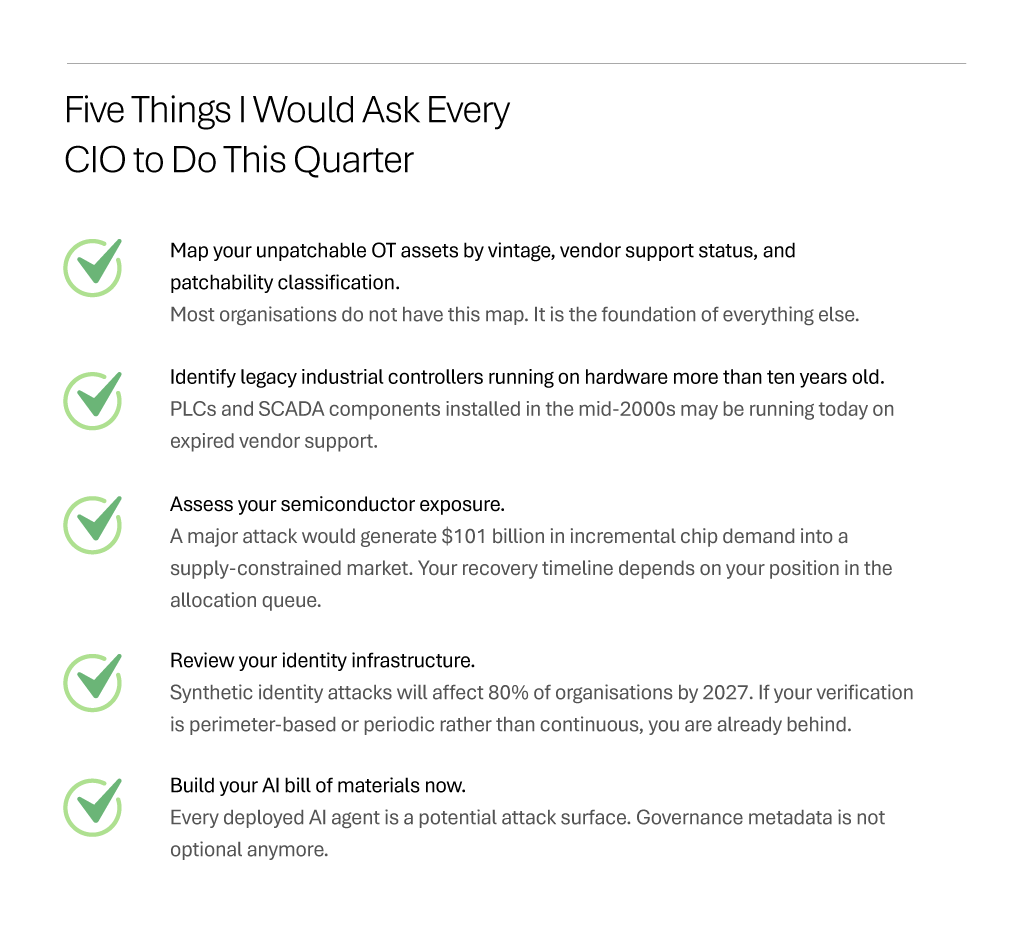
Read the full Galent CIO Brief: Mythos Exposed Your Infrastructure – a detailed breakdown of IT/OT exposure. A 5-step audit framework and what to do and plan for.
Download Now

