AI Didn’t Disrupt Tech Services… It Exposed the Truth.
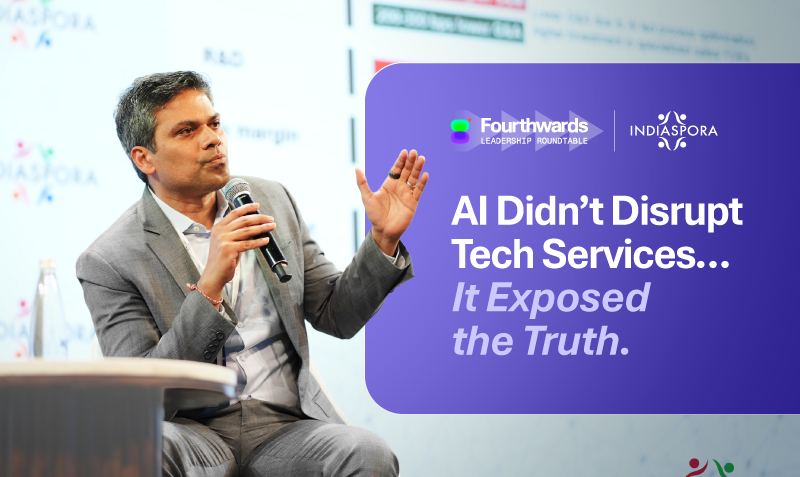
As an Impact Sponsor of the Indiaspora Global AI Summit 2026, Galent CEO Ashwin Bharath joined Sudheer Narayan from Bain & Company on the Global Race for AI: Navigating the Next Tech Services Revolution panel. The session addressed a question the industry has long resisted confronting directly: what is actually driving the structural challenges facing tech services, and what does a credible path forward look like.
The prevailing narrative is that AI disrupted tech services. We disagree. AI did not create the fracture in this industry — it exposed one that had been widening for over a decade.
Below is a summary of what was discussed on stage, and why we believe the decisions made in the next 12 to 24 months will determine which companies lead the next era of the industry — and which do not.
Part 1: The case for change
The writing was on the wall since 2014
Sudheer opened by contextualizing the current slowdown: the last eight to ten quarters have seen sustained margin compression and valuation decline across the sector. The roots of that deterioration, however, go back considerably further.
From around 2014, as digital transformation generated unprecedented demand for technology talent, the industry made a consequential shift: it moved away from owning delivery outcomes and toward fulfilling headcount. Staffing company margins rose. Tech services margins declined. The two trend lines were converging, and the signal was largely overlooked.
“
What was a slow coup for 40 years is now being made a sudden coup by AI.
AI did not create this problem. It accelerated the consequences of it. The question now is whether the industry responds with structural change or defaults to incremental adjustments that delay rather than resolve the underlying issues.
The headwinds are real — but so are the opportunities
Sudheer laid out the structural headwinds clearly: AI is compressing traditional service delivery, the GCC trend is pulling work in-house, and a post-global world is making cross-border labor movement harder.
The picture is not uniformly negative. Significant new areas of demand are emerging — mainframe and COBOL modernization, domain-specific and edge LLMs, and underserved markets including Japan, the EU aging economy, and the UAE. The aggregate market will expand. The central question is which players are positioned to capture that expansion.
As Sudheer put it: there will be winners and losers. Winners’ P&Ls will start to look like software companies. Losers’ will look increasingly commoditized. That gap will define the next decade.
Part 2: The talent rethink
The wrong frame is costing the industry
Much of the industry’s early encounter with AI came through consumer interfaces, which framed it as an enhanced productivity utility — a more capable search or a faster way to draft text.
That framing is fundamentally insufficient for understanding the strategic implications.
“
AI has a million Einstein brains embedded in it. The question isn’t what it can do — it’s whether we know how to use it.”
Anthropic recently published data showing that 73% of the expertise required for tech services delivery is already available in LLMs — spanning multiple roles, implementation phases, and domains. This is not a productivity enhancement. It is a capability shift.
The forward deployment engineer
Palantir introduced a term that is starting to resonate with enterprise clients: the forward deployment engineer (FDE). Not a software engineer, not a full-stack engineer — but someone who can harness the full breadth of AI capability across any domain, role, or delivery phase, and translate that directly into client outcomes.
When Ashwin raised this concept with the summit audience, almost no one indicated familiarity with the model. That knowledge gap is itself an indicator of how far the industry has to travel.FDEs are not just delivering 10x productivity. They are delivering 10x capability. That is a fundamentally different value proposition.
The pyramid is becoming a pillar
The talent pyramid that built this industry — a large base of junior resources narrowing toward senior specialists at the top — is being reshaped. What replaces it is a pillar model: a smaller, more capable human layer working alongside agents that fill what was previously the middle of the pyramid.
Entry-level talent remains part of the model. However, the assumption that employers will absorb undifferentiated graduates and develop practitioner capability over multi-year cycles is no longer viable at scale.
The education emergency
Higher education is not adapting at the pace the transition requires. Without substantive public-private partnerships, domain-specific curricula, and practitioner-integrated training programs, the consequences extend well beyond business model disruption.
“The next five years of graduates might become the forgotten generation — people who ended up without jobs not because there weren’t opportunities, but because the education system didn’t equip them for what those opportunities required.”
This is a call to action for institutions, employers, and policymakers. The window for proactive intervention is narrowing.
Part 3: SaaS disruption and where services wins
Not all software is equally at risk
Sudheer presented a framework for thinking about enterprise software exposure: mapping platforms on two axes — how much AI enhances the user of the software versus how much AI displaces the software itself.
Some categories — workflow tools, point-solution SaaS, and anything where the entire value lives on screen — are highly exposed. Core ERP and backend-heavy platforms are more durable. But the seat-based pricing model that built the SaaS industry is under serious strain. Consumption-based pricing is one attempt to adapt, but it may not be attacking the right problem.
Where services has a genuine advantage
Galent sees significant opportunity in precisely this transition. Enterprises that have invested hundreds of millions of dollars in SaaS platforms facing displacement require experienced partners to design and execute migration programs, build data strategies, and re-architect integrations.
Services firms with deep domain expertise and proven delivery capability are well positioned to capture this demand. The scale of migration work ahead may represent one of the largest such cycles the industry has seen.
Two things every services leader should act on now
1. Avoid the revenue trap
A common dynamic is playing out across the sector. Companies continue to generate revenue. Boards and investors interpret that revenue as validation that the model remains sound. The implicit question — why change what appears to be working — suppresses the urgency for structural investment.
Revenue is a lagging indicator. The structural shifts in delivery models, client expectations, and value creation are already underway. By the time those shifts register in the revenue line, the opportunity to respond strategically will have passed.
The companies that lead the next cycle will be those that chose to reinvent their delivery model before market pressure made it unavoidable.
2. Avoid the acquisition trap
A second pattern merits attention: services companies pursuing inorganic growth through acquisitions of distressed competitors, adjacent capabilities, and increasingly, GCCs.
Inorganic revenue is not a strategic foundation. It defers the underlying challenge while adding integration complexity and organizational debt. The compounding effect of that debt becomes a constraint precisely when the business needs agility most.
“There’s no such thing as death by a thousand cuts — until there is.”
The organizations that build durable businesses through this transition will be those that invest in structural innovation — in talent models, proprietary platforms, and modern delivery architectures — rather than using consolidation as a substitute for it.
What comes next
The tech services industry is at a structural inflection point. AI has not caused this moment — but it has removed the option to defer the decisions that this moment demands.
The opportunity is real. New spend areas are significant. The markets opening in Japan, the UAE, and across Europe are substantial. The migration and data work ahead is enormous.
Capturing that opportunity requires a fundamentally different operating model, a reconsidered talent strategy, and a clear-eyed understanding of where value is created in an AI-enabled services environment.
This is the work Galent is focused on. If your organization is working through the strategic implications of this transition, we welcome the conversation.
Watch the full session
Global Race for AI: Navigating the Next Tech Services Revolution — Indiaspora Global AI Summit 2026
Galent is an AI-native digital engineering company and Impact Sponsor of the Indiaspora Global AI Summit 2026. Ashwin Bharath, CEO of Galent, participated in the Global Race for AI: Navigating the Next Tech Services Revolution panel alongside Sudheer Narayan, Partner at Bain & Company.

