The Grand Prix Model of AI Delivery
I’ll be honest with you. I am not the engineer in the room. I don’t write the code. I don’t architect the systems. I am the person who nods confidently in technical meetings and then rushes to learn what I nodded for. But I have spent enough time around brilliant technologists to know when something is genuinely different.
AI-native software development — what the practitioners call Spec Driven Development — is genuinely different. Different in the way that changes how you compete. Different in the way that makes everything that came before it look like a horse and buggy.
Let me tell you how I think about it.
01- The Machine: Your AI Stack is a Formula 1 Car
A Formula 1 car is the most advanced automobile human beings have ever built for sustained performance. Every component is engineered to tolerance levels that would make a Swiss watchmaker nervous. The aerodynamics, the suspension geometry, the fuel mix, the tire compound — none of it is approximate. All of it is precise. All of it is interdependent. All of it is designed to outperform anything we know of. Pull one thing out of alignment and the whole system underperforms.
Or worse. Usually worse.
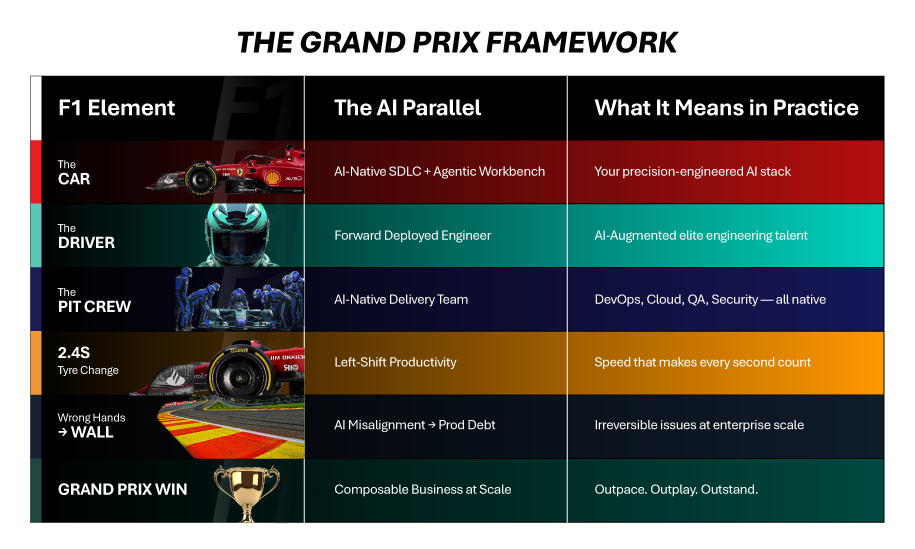
An AI-native SDLC is that car.
The infrastructure has to be tight. The architecture has to be right. The engineering, the models, the APIs, the data pipelines, the context management, the observability layer — all of it must be precisely fit and plumbed together. We call this Spec Driven Development: a disciplined, AI-native approach to software delivery where every layer of the system is purposefully designed, not loosely assembled.
There is no “good enough” in this world. A loosely assembled F1 car doesn’t finish second. It doesn’t finish at all. It finishes in a wall, on fire, being photographed by people with better seats than you.
“
There is no ‘good enough’ in AI-native delivery. Precision is not a feature. It’s the entry fee.
02 – The Mistake: Handing the Keys to the Wrong Driver
Here is where most organisations make the mistake. And it is a spectacular mistake.
They want the car and they get the car. They are very proud of the car. They take pictures of the car. They put the car in the press release. And then they hand the keys to someone who has driven a Toyota Camry their whole life — or worse, give it to a vendor who has been a trucking company for their entire existence — and say: go win.
That is not a strategy. That is an expensive accident waiting to happen. And the accident will not be cheap.
An F1 car in the wrong hands doesn’t just underperform. It is genuinely dangerous. To the driver. To the team. To everyone on the track. The same is true with AI at enterprise scale. Deployed without the right expertise, it produces irreversible issues that ship to production, security vulnerabilities nobody noticed, and technical debt that compounds faster than anyone can manage. By the time you notice, the wall is already very close.
We see this pattern repeatedly. A business invests in the best AI tooling available — best-in-class Agentic Workbench, cutting-edge LLMs, enterprise-grade APIs — and then pairs it with a delivery team that was trained for a different era entirely. The tools are ready. The people are not. And in AI-native delivery, that gap is not recoverable without stopping the car.
03 – The Driver: The Forward Deployed Engineer
You need an F1 driver. Someone with thousands of hours of reps. Someone who feels the car, reads the track, and knows exactly how hard to push without losing control.In the world of AI-native delivery, that person is the Forward Deployed Engineer.
Not a junior developer who watched a YouTube tutorial at 1.5× speed. Not a generalist who has retrofitted AI prompting onto a traditional engineering workflow. A seasoned software engineer who has been specifically trained to operate at the frontier of AI tooling — someone who knows the beast, respects the beast, and can make the beast sing.
This is what the Galent model is built around. Our AI-Augmented Engineering approach pairs elite engineering talent with AI-native tooling as a single, integrated capability. Not AI bolted onto a legacy team. AI-native from the first line of code to the last pull request.
The distinction matters enormously. Traditional software engineering optimises for predictability — known inputs, known outputs, well-trodden patterns. AI-native engineering optimises for velocity at the frontier, where the patterns are still being written, the tooling is still being calibrated, and the competitive advantage belongs entirely to the team that can adapt fastest.
“
“The competitive advantage in the Age of Intelligence belongs entirely to the team that can adapt fastest.”
04 The Crew: Your AI-Native Delivery Team
Even the best driver does not win a Grand Prix alone. Ask any champion and they will tell you: the trophy belongs to everyone.
The pit crew that changes tyres in 2.4 seconds, manages fuel load, monitors telemetry, calls the strategy from the wall — that crew is the difference between a podium finish and a DNF. Every second is a competitive advantage. Nobody is waiting for a committee to approve the tyre change.
In an AI-native delivery team, that crew is the DevOps engineer, the cloud architect, the QA specialist, the security lead. Each one thinking natively, operating at high efficiency, doing their job in seconds not minutes. This is what Left-Shift Productivity looks like in practice: not a methodology slide, but a team that has internalised the speed of the machine and refuses to be the bottleneck.
This is also where Galent’s approach diverges fundamentally from the traditional SI model. Legacy systems integrators were built for a different race — long delivery cycles, waterfall-adjacent governance, large teams moving at the pace of the slowest member. That model was never designed for the velocity of AI-native delivery. It is a trucking company trying to compete in Formula 1.
Galent’s crews are built differently. Organised around our proprietary inversion of Conway’s Maneuver — designing team structure to drive the architecture you want, not inheriting the architecture your org chart produces — our delivery teams are composable, AI-native, and calibrated for the speed of the modern race.
05 – The Podium: Winning in the Age of Intelligence
To deploy a production-grade application in today’s environment — to actually win the Grand Prix — you need all three: the machine, the driver, and the crew. Miss any one of them and you are not racing. You are spectating from the gravel, wondering where it went wrong.
AI is the most powerful development accelerator we have ever had access to. The results it can produce — the speed, the quality, the scale — are unlike anything that came before it. But it is not a self-driving car. It is an F1 machine. And F1 machines do not reward wishful thinking.
They reward preparation, expertise, and the right team around them.
At Galent, this is what we build. Not just the tooling. Not just the talent. The complete, integrated, AI-native delivery capability — machine, driver, and crew — that organisations need to stop spectating and start competing.
Get the machine right. Get the driver right. Get the crew right.
Then watch the podium position.
About the Author
Ashwin Bharath is the CEO of Galent. With a career spanning enterprise technology, workforce transformation, and AI-native delivery, Ashwin has spent over two decades at the intersection of human ingenuity and technological change. At Galent, he leads the mission to help businesses transform into AI-driven composable ecosystems — combining elite engineering talent, proprietary AI tooling, and a Change Management-First approach to delivery. He writes and speaks regularly on the future of AI-native organisations, the talent imperative in the Age of Intelligence, and what it actually takes to win when the tools have changed but the teams haven’t.

Ashwin Bharath – CEO,Galent